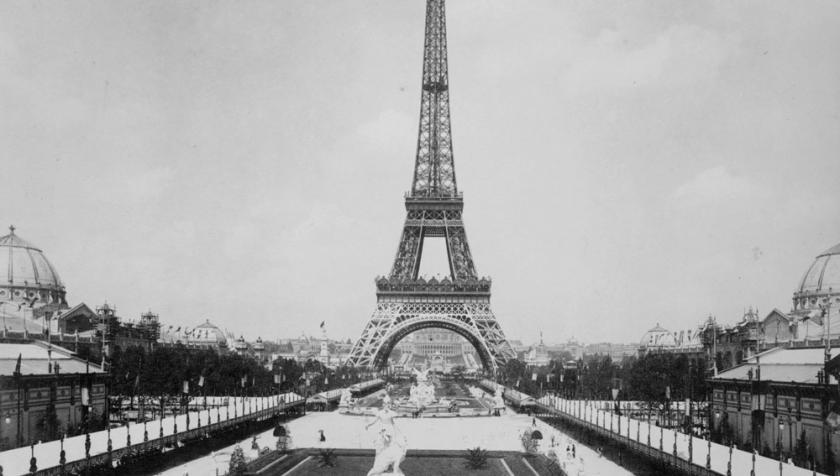
Having read Prof. Smith's journal on the Blood Red Fez, the 1923 investigators become convinced that the simulacrum story is not a mad man's dream but indeed represents serious danger. The team decides to depart for Paris as soon as possible, in order to investigate Smith's clues.
Initial clues
Paris is where the Sedefkar Simulacrum was last seen as a whole. Its last known owner was a nobleman known as Comte (count) Fenalik. The simulacrum was dismembered in the eve of the 1789 revolution and its pieces were carried off to different destinations. Perhaps by investigating the last known owner, investigators can find clues as to its fate. Also, Smith's notes mention that the 13th century manuscript "the Devil's Simulare" that holds clues as to the nature and powers of the artifact may also be located in the national library.
After loading their travel inventory, the investigators depart London on the 9th of January, headed for Paris.
The City of Light
Paris in the winter of 1923 is in upheaval: France is about to invade the Ruhr valley in Germany in response to unpaid war reparations, and political tensions are running high in the streets, cafes and gathering places of the french capital.
Oscar leads the investigators to a hotel and immediately afterwards to father Julien's residence. Oscar's tutor is well versed in the occult and may provide them with hints on where to begin their search: the team narrates the London events and asks for insight. Father Julien realises the importance of their mission and proposes the national library as their ideal first stop: the second largest library in the world contains a treasure trove of information for those able to navigate its enormous collection. He also directs them to Remi Vangeim, a post-doctoral philosophy researcher and associate of father Julien, who knows the library well and is a man of confidence.
Bibliotheque National de France

Dr. Hart had already sent admittance paperwork to the library from London, so the investigators enjoy immediate access to the library. Book access is by form request after perusing the index, a time-consuming process. A quick browsing shows no references to the Devil's Simulare. Oscar locates Remi in a study room, and he introduces the team and hires the researcher to help them find references to the Simulacrum, the Devil's Simulare or count Fenalik.
The first two objectives are difficult to pursue initially, however a record does turn up regarding the count: At the eve of the French Revolution, Comte Fenalique is mentioned in a royal raid:

Remi suggests that all raids by the royal guard are archived, and may be accessed in the military records of L'Arsenal. Heading there, the investigators manage to locate the record of the raid in count Fenalik's estate, as written by the captain of the guard.
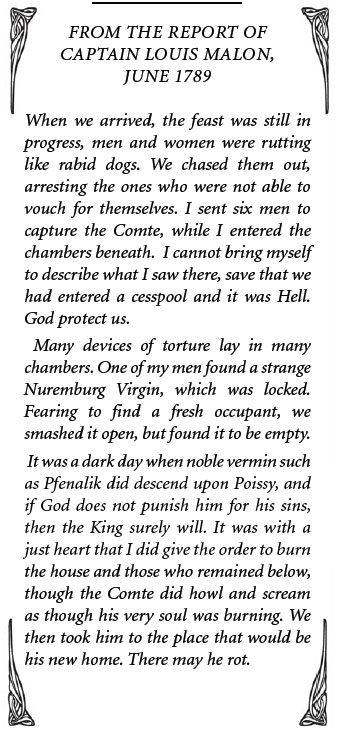
This record positions Fenalik's estate in the village of Poissy, a few miles to the northwest. It is evident the count was deranged and dangerous, but could not be executed because he was a noble. He must have undergone some sort of trial or legal proceeding, of which some remains may be found back in the national library. Indeed, exhaustive search provides an interesting account of the royal physician who examined Fenalik prior to trial:
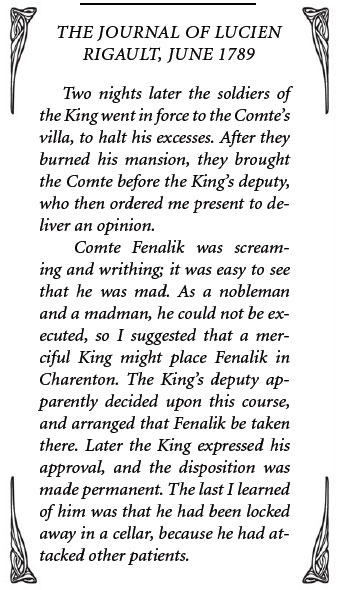
The count was declared mad and dangerous, and committed without trial in the Charenton Asylum (later famous for the imprisionment of famous inviduals such as marquis de Sade). Investigating more on the asylum, a news story from last week stands out: the director of the asylum was killed in a tragic accident. There may be more here that merits further investigation.
The team leaves Remi behind in the library to continue the search, while they head off to visit the asylum in person.
Charenton Asylum
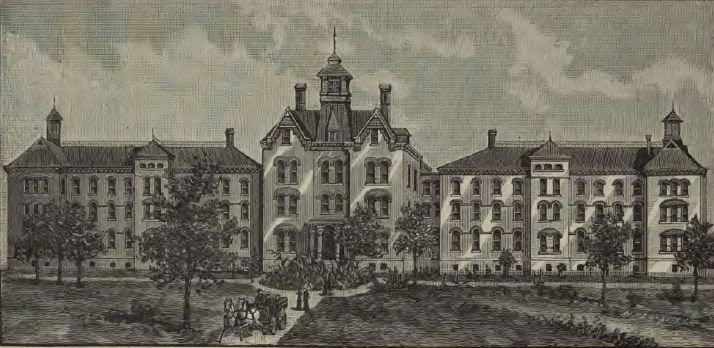
The 16th century massive structure is gloomy and imposing, a dark stony menacing shadow in the winter landscape. The change of director seems to have upset the normal routine of the mental institution, and everyone is still adjusting to new regulations. What happened to the old director is not immediately clear, as the staff have been instructed to avoid talking about the sensitive issue.
Most of the team heads to the director's secretary, asking to see the historical patient records of the late 18th century claiming research interests. The secretary leads them to a storage room and hands them crates of record binders. In the corridor outside the archive room, Mudiwa notices a cart of personal belongings and files, one of which stands out: "E. Delplace - Events 1923". He quickly pockets the old director's diary behind the secretary's nose. Meanwhile, Dr. Hart tries to find out what really happened to the old director.
Initial clues
- Count Fenalik was indeed admitted to the asylum in June 1789, as his admittance records confirm. However, there is no death or release certificate, unusual even for old records like these.
- A drunkard guard tells a story about a guard that was regularly abusing inmates in the lower, locked-off dungeons of the facility. Some ten days ago he was found unconscious and bleeding, and next to the guard was a strange man, naked and critically underfed in a catatonic state. The guard received medical care but has been delirious since, and ended up in the inmate general population. As for the stranger, he was placed in the old director’s care for treatment.
- Dr.Delplace’s death is attributed to electrocution due to a malfunction of the new electroshock machine the director was testing out.
- The day before his death, the director is heard murmuring that he is “close to tapping into the collective racial memories” and about “dreaming back in time”.
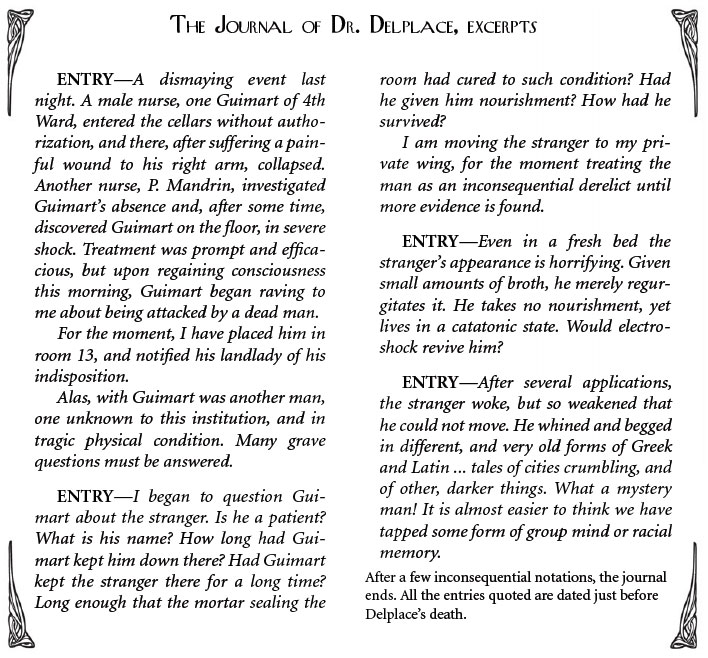
Dr.Delplace’s personal journal indicates that the stranger was not identified as any of the asylum inmates, but electroshock therapy proved somewhat effective:
Confrontation with the director
Armed with lots of information, the investigators confront the new director demanding access to the stranger. Initially, Dr. Leroux is angered and threatens to have them thrown out or arrested - as the team explains the potentially disastrous consequences of going public with what they know, he reconsiders and reluctantly agrees to cooperate.
Dr. Leroux unlocks the private ward and leads them to the electroshock chamber where the old director’s body was found. The body was impaled on the two electrode rods of the grand-guignol construction, a feat that would take superhuman strength to achieve. The stranger has since disappeared - nobody saw him since the director’s death.
Examination of the pervert guard reveals nothing - he is in a straitjacket, unresponsive and can provide no clues. His wound in his arm indicates some sort of large claw wound.
Examining the dungeon
The team asks for access to the dungeon where the stranger was found. Mudiwa goes there with a guard, crossing the most dangerous ward of the institution. The place where the guard and the stranger were found dates back to the original foundation of the building, some three centuries ago, and is in a state of filthy, dangerous disrepair. The stranger was found in an alcove barely big enough for a human body, and the brickwork seems solid but moldy. Clues point to someone having been buried alive in the brickwork several decades ago - this was certainly not the work of the guard.
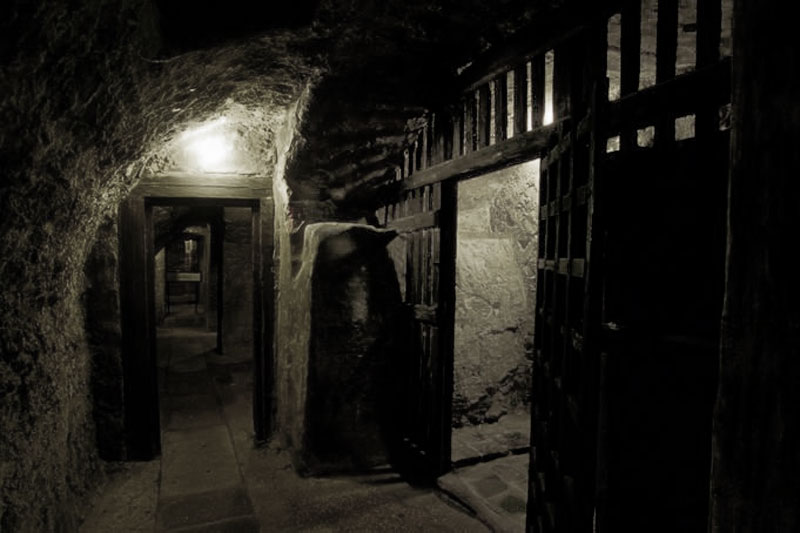
Mudiwa has an ominous feeling, as if he and the guard were not the only ones in this dark place. He names Fenalik and mutters about the Simulacrum, attempting to draw the presence out. Indeed, he is successful: the guard is scared and starts heading back, Mudiwa increases his distance and suddenly notes an icy breath on his neck. Cold, hard claws clumsily caress his head for two seconds from behind, and then the presence retreats back into the shadows.
With lots of information to process, the team decides to head to Poissy, where the count’s villa stood before it was burnt to the ground after Fenalik’s arrest.